ARTEX: The AI Guardrails Are Not Failing. They Are Being Routed Around
Key Takeaways
- Do not count on AI guardrails to protect you. The frontier models refuse this work. It does not matter, because cheaper models without those refusals are now just as effective for it. Assume every attacker has a capable model that will never say no.
- Treat this as a class, and stop ignoring the scan. ARTEX is the headline, but the model, prompts, skills and infrastructure can all be swapped. An agent's opening moves look like the background noise we trained ourselves to tune out. Detect what follows: adaptive retries after a block, a predictable sequence and one target probed from many addresses.
- Get the telemetry in before you need it. Firewall and WAF logs, web and application logs including HTTP errors, database logs and host telemetry on the web tier. If those are not reaching your SOC, start there.
- Block on behaviour, and revoke when you block. Residential proxies make address blocking a losing game on its own. Act on pattern at the WAF and IPS layer, end the sessions and tokens in use, then confirm the next request fails.
- Manage exposure as a programme, not a test. Continuous threat exposure management covers the whole cycle. Scope what matters, discover what is exposed, prioritise by what an attacker can reach and connect to, validate that it is exploitable, and mobilise the fix. Continuous testing of applications is one input to that, not the whole of it.
- Patch windows have collapsed, so plan for the gap. Exploitation skills for new runtime flaws are appearing in these tools on the day of disclosure. Know which PHP, Java and web server versions you run, and where. Where you cannot patch in hours, mitigate first with a virtual patch at the WAF, authentication in front of the service, or the feature switched off.
- Hunt past the application. A runtime flaw takes the attacker onto the host. Look for code execution, files dropped in web directories, persistence, privilege escalation and lateral movement that starts at the web server.
- Assume advanced actors are in the noise. The low-skill operators are numerous and easy to spot. Capable actors are using the same tools, and the same volume and speed, as cover. An unmanaged alert queue is where they succeed.
Infrawatch's research into autonomous offensive frameworks is the most useful dataset I have seen on this problem. It analyses 128 real intrusions instead of speculating about what AI might one day do. It also matches what we see from a completely separate vantage point, and that matters more than any single headline number.
We have two reasons to hold a view. We researched the lineage, back to the original source, then rebuilt ARTEX in an isolated lab and ran a structured tuning study on it as a defender. Secondly, our BCON Collective researchers had added a new class to our malicious infrastructure tracker which has also followed these tools live since early November.
As of this week it holds 2,269 live, exposed servers matching 23 tool families, spread across almost 60 countries. These are detections of exposed infrastructure, not confirmed intrusions, and that distinction matters. ARTEX accounts for around two thirds of them. Add the rebranded forks we track under their own names and the family is over three quarters. Infrawatch sees a larger population and puts ARTEX at just over half. Different sensors, same conclusion. ARTEX is the dominant tool, and new servers have appeared in our data every day since we started tracking.
The Model Split is the Story
The quietest line in the report is the most important one. DeepSeek and Claude are the two most-used models.
When we rebuilt ARTEX, the frontier models from the big Western labs refused the offensive work. We watched Anthropic's top models return a content filter block on the attack prompts, every time. The guardrails did exactly what they were built to do.
So how does Claude end up second on the list? Attackers have two options. They drop to open and Chinese-developed models that do not refuse. Or they keep the premium model and change the route to it, or the story they tell it. Around a fifth of the routes it observed ran through a reseller or "transfer station". One actor pulled provider accounts out of exposed AI gateways and tested around 90 DeepSeek keys. Eleven actors simply told the agent it had permission to test, and the agent believed them.
The tooling now expects refusals. Within a week of the takedown, the most-forked copy had added a feature that probes how readily a configured model will refuse.
Others have now seen the same thing from the attacker's side. Check Point read the databases of ten ARTEX servers whose operators had left them exposed. The only refusals it found came from an Anthropic model, and the operator switched to a more permissive one. Elastic reviewed the source code of five of these frameworks and found that none enforces authorisation in code. Three simply tell the model the test is authorised, and one reroutes any task a model refuses.
The guardrail is not failing. It is being routed around. That is a different problem and it needs a different answer.
Cheap, Good Enough and Never Told No
There is a comfortable assumption that the dangerous AI is the expensive frontier AI. Our testing says the opposite is now the operational reality. The open-weight and Chinese models are now just as effective for this work. They carry none of the safety refusals. They cost a fraction per run. We were completing full autonomous assessments for a few dollars each. Public reporting agrees. Check Point costed three criminal campaigns at between $145 and $1,500 in model usage, and Gambit put a campaign against online retailers at about $25 a target.
Infrawatch reports that success is roughly a coin flip, with failures driven largely by model hallucination. Nobody should take comfort from that. A coin flip that costs a few dollars and can be run against thousands of targets at once is a very good bet for an attacker. That is why this is measured in thousands of servers and not dozens.
The Takedown Scattered It
People hear "the repository was taken down" and assume the problem went with it. It did not. It scattered. The original was pulled by its own author in October once the abuse became obvious. By then it had been forked thousands of times. Development did not stop either. The most-forked surviving copy has shipped five tagged releases since late October.
What is left is a family tree, not a tool. There are rebrands like ScopeWeaver, a commercial "ARTEX PRO", and delivery-enhanced forks like AntiFox being used for cloud credential theft. New names appear almost weekly. Infrawatch counting more than 130 variants is entirely consistent with what we track. Some of those copies are booby-trapped too, with trojanised forks and backdoored container images. Even the criminals cloning it are getting robbed.
We mapped the family from the commit history and fork networks of the surviving copies. It runs to almost 21,000 repositories. Around 20,100 are direct forks and more than 700 are separate re-uploads. The first commit is dated 26 July. The original author's last is 7 October. More than 700 people had forked it directly by the time it disappeared, over 300 of them on 8 October alone. Within a day, complete copies were live, and the largest now has over 7,000 forks. Other groups stripped the history and rebuilt under new names, which is where AntiFox sits. Some of those rebuilds are now being built on in turn.
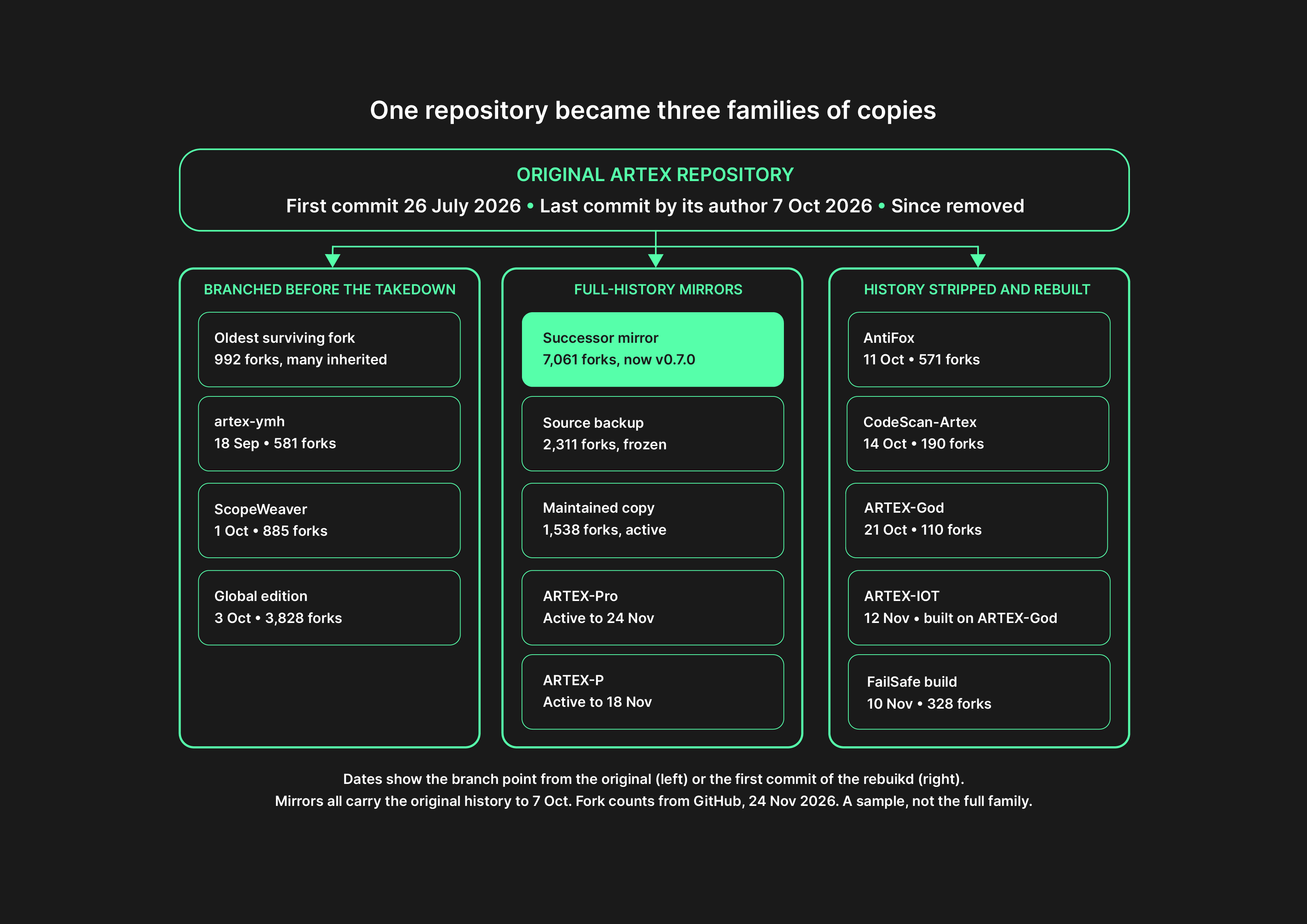
ARTEX lineage · 1 root, 3 groups, 14 repositories
Three routes lead away from one repository: branches taken before the takedown, complete mirrors made as it happened, and rebuilds that removed the history. The mirror in the centre is the one still shipping releases.
The timing tells its own story. For ten weeks the tool was a niche project with a handful of forks a day. The takedown changed that overnight. The second wave was in mid-November, as public reporting and detection content arrived, and was larger than the first.
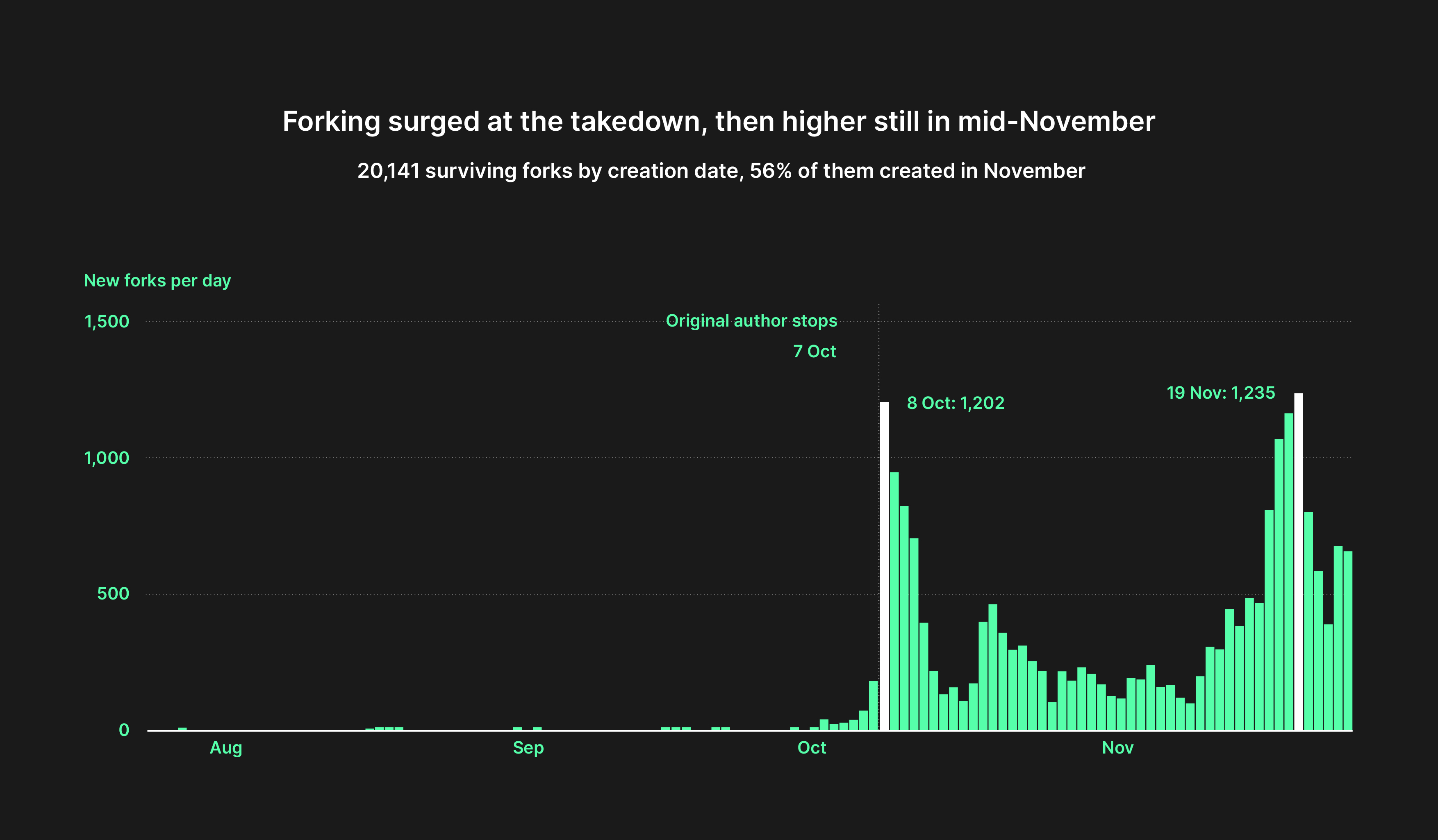
Surviving GitHub forks by creation date, 26 Jul to 24 Nov 2026
A fork is not an attacker. Many of these belong to researchers, students and defenders, and a few are detection projects. But each one is a working copy that no takedown will reach. Around 1,100 of them have had new work pushed to them in the last fortnight.
The upside for defenders is that lineage leaves marks. Forks inherit their parent's fingerprints. The same network signatures and tell-tale strings travel from fork to fork. More than four in five of the ScopeWeaver servers we track also match its parent, ARTEX. That inheritance is what lets us keep tracking a tool that has supposedly gone underground.
Discipline Beats Model Swaps
The point of our study was not to admire the tool. It was to measure what it takes to get good results, because that tells you what the adversary has to do too.
The lab was built for that purpose. It is a self-contained container environment, with the test harness, the framework and the deliberately vulnerable applications all on one internal network. It has no internet access and no network route out other than the model API endpoints. The agent has nowhere else to go.
The biggest gains did not come from a better model. They came from method. We told the agent to be exhaustive and to prove full impact instead of stopping at the first finding. We forced it to render the application and read the client-side code, which is the structural blind spot of any HTTP-only agent. Holding the model fixed and adding discipline, findings per run climbed by more than an order of magnitude.
Infrawatch reaches the same finding from the other end of the telescope. The attacks it analysed leaned on existing vulnerabilities and control failures, not novel tradecraft, and we observe the same in our own investigations. These are old attacks, run exhaustively, cheaply and at machine speed.
Two Waves Are Arriving Together
These frameworks are not arriving alone. In the last five weeks we have had PHP2Shell, a pair of remote code execution flaws in PHP itself, and Java4Shell, a memory corruption flaw in the Java runtime. Both sit underneath the web applications these agents are pointed at. PHP2Shell was exploited within days and is on CISA's known exploited list. Java4Shell followed on 17 November and is already being probed.
They are not the only ones. November has also brought exploited flaws in Apache Axis, Apache Roller and a legacy ASP.NET library. Each one gives an attacker code execution from a single unauthenticated web request. NGINX, which sits in front of a large share of the web, patched two critical HTTP/2 flaws on 18 November. No exploitation of those is confirmed yet, but that is the pattern to expect.
Put those together. We have critical flaws in the runtimes beneath the web estate, and autonomous tooling that will test every exposed application for them, cheaply and without rest. Neither is the whole story on its own. Defenders need to read the current spike as a combination of factors: more vulnerabilities, found faster, and exploited by tools that do not get tired.
The link is not theoretical. The public commit history of the most-forked ARTEX copy shows a PHP2Shell exploitation skill being added on 21 October, the same day PHP shipped its fix. Attackers now require no skill to exploit the latest zero days, the day of disclosure and well ahead of remediation activities.
It also changes what we hunt for. Application abuse is still there, with enumeration, injection and account takeover. A runtime flaw takes the attacker past the application and onto the host. So we hunt for remote code execution, files dropped into web directories, persistence, privilege escalation and lateral movement that begins at the web server.
Telemetry Decides the Outcome
Here is the good news. These agents are loud and they are consistent. Across the investigations we have run for clients, the same indicators, behaviours and tooling keep appearing. Consistent behaviour can be detected, but only if the telemetry exists.
That means four layers, collected and joined up:
- Firewall and WAF logs
- Web server and application logs, including HTTP error logs
- Database logs
- Host telemetry such as EDR on the web and application servers
No single layer tells the story. The WAF shows the probing. The error logs show what the application did with it. The database shows what was read. The host shows whether the attacker got out of the application and stayed. If your web, application and database logs are not reaching your SOC, start there.
Block on Behaviour, Not Address
Infrawatch records actors routing through residential proxy networks, and we are seeing that in more attacks. It matters because a residential address looks like a customer. Block it and you block real users. Blocking by IP address alone becomes a losing game, and it loses faster as more actors make the switch.
Blocking has to become dynamic. That means acting on behaviour and pattern, most likely at the WAF and IPS layer, where a decision can be made in the flow of traffic. The open defender community has already described what to look for, and none of it depends on knowing the address in advance:
- Mixed intent in one session. A single source that enumerates paths, probes parameters and attempts authentication in one continuous run.
- Adaptive retries. Requests that keep coming after a 403 or a 429, each one slightly changed in response to the last error. A person backs off. An agent adjusts and tries again.
- A predictable sequence. Configuration and API documentation are fetched first, then routes that have never been requested before, with almost no delay between stages.
- Machine cadence. Login attempts at a steady rhythm across many accounts, with the user agent rotating between bursts.
- One target, many addresses. The same application probed through hundreds of rotating proxies. Look from the target outwards and the pattern is obvious.
- What happens next on the host. A web or database service starting a shell, scripts written into web folders, and servers calling out to webhook and tunnelling services.
The same community work sets out a sensible structure. Indicators form the bottom layer and they expire. Behaviour sits above them and lasts. Correlation across sequence, timing and identity sits at the top, because any single event is weak evidence. Infrastructure intelligence still earns its place for scoring and for forcing rebuilds. It just cannot be the only control.
The Noise is Now a Shared Problem
This is not only showing up in datasets. Our offensive security teams are seeing more of this activity. I hear the same from leaders across the industry through the forums and working groups I am part of.
The response is encouraging. Vendors and national CSIRTs are sharing intelligence and indicators on these frameworks to cut through the wave of noise they generate. That noise is a risk in its own right. An autonomous agent working through a checklist is loud, and it can bury the human operator with real intent. Shared intelligence and non-brittle detection, blended with their own AI tooling is how defenders take that noise out at scale, so analysts spend their time on what matters.
A lot of that work is being given away. There are free, open detection packs for ARTEX and its relatives in Sigma, Microsoft Sentinel and Defender queries, Suricata, YARA and STIX. The better ones favour behaviour over indicators, because an operator can swap the model or the server in minutes and cannot easily change how an agent behaves. No defender has to start from zero on this.
Run The Same Play First
If adversaries are running autonomous assessments against our exposed web and API estate before they attack, the only coherent answer is to run the same play first. That means continuous exposure management, not an annual penetration test. The skill floor has dropped to near zero. Infrawatch's duration data shows many intrusions start and finish inside a single day. A once-a-year manual cycle cannot meet a threat that moves in hours.
The second half of the answer is infrastructure tracking. Infrawatch found that in 45% of intrusions the traffic came straight from the framework's own server. That makes the infrastructure itself a usable signal. Our tracker flags these frameworks as a live AI Threat category for exactly that reason.
The infrastructure is also more concentrated and more stable than people assume. In our data, eleven networks carry half of the servers. Hong Kong, the United States and China host more than half between them. Close to nine in ten of the servers we have recorded were still live at our most recent scan. These operators are not hiding and they are not moving. That is an opportunity.
It is also not where people expect. With traditional command and control we are used to bulletproof hosting that ignores abuse reports. This is different. At least a quarter of the servers we track sit on the large Chinese cloud platforms. Around one in six sit with mainstream Western providers. Much of the rest is low-cost virtual server hosting in Hong Kong and wider Asia Pacific. Hosts with a reputation for ignoring abuse account for only a few percent. This is commodity cloud, rented by the hour, and commodity cloud has terms of service and abuse desks. It can be reported and it can be removed.
Blocking will not stop the first request. Mapping the servers, and the proxies and relays they exit through, forces the attacker to keep rebuilding. Nobody should expect the model providers to solve this for us. A ban on one provider does not stop an operator. The Chinese models are far cheaper and now just as effective, so the operator simply moves. The pressure that works is the pressure defenders apply themselves. Report the hosting, burn the infrastructure and close the exposure before the agent finds it.
Beyond ARTEX: From Noise to Scrutiny
ARTEX holds the headlines, but it is one framework in a class. The better name for that class is agentic offensive frameworks, or AOFs, the term Mandiant introduced. Our tracker follows 23 of them and Infrawatch counts 51. A third of the servers we track run something that is not ARTEX by name. Other public counts of exposed consoles range from about 1,500 to more than 5,000, depending on method and date. Every one puts ARTEX first, with PentAGI and CyberStrikeAI the most common of the rest.
The users are just as varied. Microsoft tied ARTEX to a China state-aligned actor in the ConnectWise supply chain compromise, where agents attempted sign-ins to more than 2,250 tenants and in some cases reached privileged cloud access in under three hours. CrowdStrike reported a China-nexus group pointing a single ARTEX controller at more than 200 organisations in 14 countries over 11 days. Unit 42 described a Cairn campaign that breached 10 of 19 targets across semiconductors, defence policy and civil society. Gambit reconstructed a criminal campaign against online retailers. Mandiant has met these frameworks in its own incident response work since late August, and the FBI issued a FLASH on ARTEX on 13 November. This is no longer one tool or one kind of actor.
Florian Roth of Nextron Systems has made the point that matters most here. These are not malware families and they are not command and control frameworks. The model, the prompts, the skills, the tools and the infrastructure can all be swapped. The framework does not decide what lands on a victim's systems. An exploit or a webshell does not become an ARTEX indicator because ARTEX delivered it. That is why we track the consoles themselves as exposed infrastructure, and build detection for the victim side on behaviour.
They are also evolving in public. The commit history of the most-forked copy shows what six weeks has added: skills for newly disclosed vulnerabilities, rotation between several models, a probe for model refusals and, in mid-November, optional noise profiles that pace requests to run low and slow. Loud is today's default. It is not a property defenders can rely on.
The direction of travel is clear. Mandiant expects stealthier, fully autonomous operations on obscure infrastructure or self-hosted models within months. A self-hosted model has no provider to refuse a request or ban an account, which removes one of the few points of friction we have today.
Roth's wider argument, in a piece on what he calls defensive minimalism, is that this changes who gets an attacker's attention. He describes three periods. Until about 2000 the internet was quiet, and if you were attacked a person had chosen you. Then came twenty-five years of noise, with constant scanning that gave every target the same checks. A close look still needed a skilled person, and skilled people were scarce. Now an attacker can move on and leave an agent behind to take the second look. Close attention used to be rationed by people's hours. It is now rationed by compute, and compute is cheap. He cites Justin Elze of TrustedSec: "Limited attacker attention was never a control."
Two of his observations match what we see in investigations. Being unique no longer protects you. The bespoke application or old API that never justified an attacker's afternoon now gets one. And history has become attack surface. Old commits, build logs, forgotten subdomains and even archived copies of a website are all read. He adds a warning for every SOC. The opening moves of an agent look exactly like the scanning we trained ourselves to ignore. The difference is in what follows.
His answer is to choose the ground. Start from the smallest set of capabilities people need to do their work, and make every exposed feature, port, plugin and access right justify itself. That means a few well-defended entry points in place of a long front. It does not replace the basics. It demands excellence at them.
Put that together with what we see across our own clients, and the focus areas for resilience are clear:
- Expose less. Withdraw what is not needed, put what remains behind authentication, and check from the outside that it cannot be reached another way. Start with administration and management interfaces.
- Clean up your history. A secret in an old commit, a build log or an archived page stays valid until it is rotated. Short-lived credentials and fewer integrations remove routes nobody then has to monitor.
- Treat bespoke applications as targets. They were protected by being uninteresting. That protection has gone. Rate limits and volume thresholds on high-impact functions turn an agent's persistence into alerts.
- Be excellent at the basics. Phishing-resistant MFA, faster patch cycles, old protocols switched off and tested offline backups are what stop an agent once it has found something.
- Rank by connection, not rarity. "We rarely see this exploited" was a fair argument when few targets got a close look. A low-severity finding now matters because of what it connects to.
- Know your assets well enough to automate response. An alert arrives in seconds. The decision to isolate a production system can take an hour, and an agent uses that hour. Decide in advance which detections trigger containment. Automation is only safe where the inventory is right.
- Revoke, do not just block. A blocked agent comes back from a new address. Pair every block with revoking the sessions and tokens it was using, then confirm the next request fails.
- Instrument everywhere, and detect on behaviour. CrowdStrike reported one operator steering its agents away from hosts protected by EDR, so coverage gaps are where an agent settles. Agents act in bursts of seconds inside operations that run for hours. Correlation needs a long memory.
The Barrier to Entry Keeps Falling
Step back and this is a continuation of something we have watched for years. Each wave of tooling lowers the barrier to entry. This one lowers it further than any before. A capable web attack no longer needs a capable attacker. It needs a free tool, a cheap model and a rented server.
That brings a different kind of actor into the market. They are commercially motivated, they are trying to make money with cheap or free tools, and there will be a lot of them. They will also be the easiest to spot. Low sophistication means default tooling, default behaviour and little effort to hide.
The second effect matters more. The same tools are open to advanced actors, and the noise and speed give them cover. A capable operator running one of these frameworks looks like every other user of it, until the moment they do not. They can hide in that volume, move at the same pace and succeed without detection.
That is only true where the exposure has been left unmanaged. This is the case for continuous threat exposure management. Find and fix what the agent would find, and mitigate the risks you cannot remove, before either kind of actor arrives. The defence does not need to be exotic. It needs to be continuous, well instrumented and shared.

Martin Riley
Chief Technology Officer
 Blogs
 Blogs