
Intelligence Insights: October 2026
Intelligence Insights
PHP2Shell and Teams social engineering: two routes into the organisation.
The Bridewell Threat-Led Approach
Bridewell’s managed security services are built upon a proactive, threat-led defence strategy. Moving beyond reactive monitoring, we actively track adversary infrastructure and tradecraft. By seamlessly integrating Cyber Threat Intelligence (CTI), Incident Response (IR), and Managed Detection and Response (MDR), we ensure our clients remain ahead of the evolving threat landscape.
In a landscape defined by rapid adaptation, knowing what is attacking you is just as critical as knowing how. This month’s Threat Insights leverages data from Bridewell’s global MDR and Incident Response engagements to expose the top malicious infrastructure of October 2026. We go beyond the headlines to provide actionable detection guidance on the month's threat insights, equipping your team with the foresight to stay one step ahead.
Top 5 Malicious Infrastructure Threats Tracked
| Name | Category | October. Vol | Monthly Trend |
|---|---|---|---|
| cyberstrikeai | Exploitation Framework | 329 | Increasing |
| ARTEX C2 Framework | Exploitation Framework | 288 | Increasing |
| Cerberus-Android | Remote Access Trojan (RAT) | 199 | Increasing |
| Amnesia Stealer | Remote Access Trojan (RAT) | 195 | Increasing |
| PentAGI | Pentesting Tool | 192 | Increasing |
Threat Detection Insights - October
This month's CTI Insights covers two developments at opposite ends of the attack surface. The first is PHP2Shell, a pair of critical memory-safety vulnerabilities in the PHP interpreter itself (CVE-2026-109618 and CVE-2026-109619) that can enable unauthenticated remote code execution and exposure of sensitive process memory on systems running vulnerable PHP versions. Discovered with the help of frontier AI models, made public ahead of coordinated disclosure and targeted by exploitation attempts even before its official public disclosure, it represents one of the most significant PHP security events in recent years and deserves the attention of organisations running PHP directly or through third-party products.
The second is the continued rise in voice phishing and social engineering conducted through Microsoft Teams. Rather than exploiting a software flaw, this technique exploits the trust organisations place in their collaboration platform, with attackers posing as IT support, flooding targets with spam to create a pretext, and then talking their way into a remote-access session. The technique has been adopted by multiple financially motivated threat actors and has been associated with ransomware operations.
PHP2Shell
| Vulnerabilities | CVE-2026-109618 · CVE-2026-109619 |
|---|---|
| Severity | CVSS v4.0: 9.2 each |
| Potential impact | Remote code execution and sensitive process-memory disclosure |
| First fixed releases | 8.2.35 · 8.3.36 · 8.4.27 · 8.5.12 |
| Scope | Web-serving PHP runtimes, including those bundled in applications and container images |
PHP2Shell is the name given to a pair of critical memory-safety vulnerabilities in core PHP, tracked as CVE-2026-109618 and CVE-2026-109619, each carrying a CVSS v4.0 score of 9.2. The flaws lie in the PHP interpreter itself rather than in an application framework, meaning vulnerable deployments can potentially be exploited even when the application code running on top of PHP does not itself contain the underlying vulnerability. Wiz Research, which published the headline research and coordinated the disclosure, states that PHP powers around 70% of websites and has compared the potential significance of PHP2Shell to vulnerabilities such as Heartbleed and Log4Shell. Credit for the underlying findings is shared across several researchers. Calif and OpenAI independently reported the same core weakness during the same period.
What is PHP2Shell
The vulnerabilities can allow an unauthenticated attacker to execute code remotely on an affected server and, separately, to read raw memory from the PHP worker process. That leaked memory can contain passwords, authentication tokens, API keys and certificates belonging to other users' requests or to the server itself. PHP releases dating back to version 5.4 are affected by at least one of the vulnerabilities, with web-facing deployments including Apache's mod_php, PHP-FPM, php-cgi, FrankenPHP and LiteSpeed considered in scope. Exploitability and specific attack paths can vary depending on the deployment model and configuration. The primary concern is PHP runtimes serving HTTP requests, including those bundled inside container images, which may run a different PHP version or configuration from the command-line installation.
How PHP2Shell was disclosed
- 19 Aug - First vulnerability discovered
- 17 Oct - Exploitation attempt recorded
- 20 Oct - Technical details became public
- 21 Oct - Security release brought forward
- 22 Oct - Originally planned disclosure
The research is notable for being substantially AI-assisted. Wiz used frontier models, including Google's Gemini 4 Argon and OpenAI's GPT-5.6 Sol, to help identify the vulnerabilities and develop and adapt working exploits across different environments. The underlying weaknesses had existed for years; what changed was the cost and complexity of turning them into reliable exploits, with frontier AI significantly lowering the barrier to adapting exploitation techniques across different PHP versions and configurations.
The coordinated disclosure did not go entirely to plan. Wiz discovered the first vulnerability on the 19th of August 2026 and subsequently reported its findings through coordinated disclosure. Technical details became public on the 20th October, ahead of the planned disclosure on the 22nd October, prompting the PHP team to bring its security release forward to the 21st October. Most significantly, exploitation attempts preceded public disclosure: Amazon's MadPot honeypot network recorded an attempt on 17th October, four days before patches became available. Exploitation activity escalated rapidly as details became public, with broad scanning and exploitation attempts subsequently observed in the wild.
How PHP2Shell works
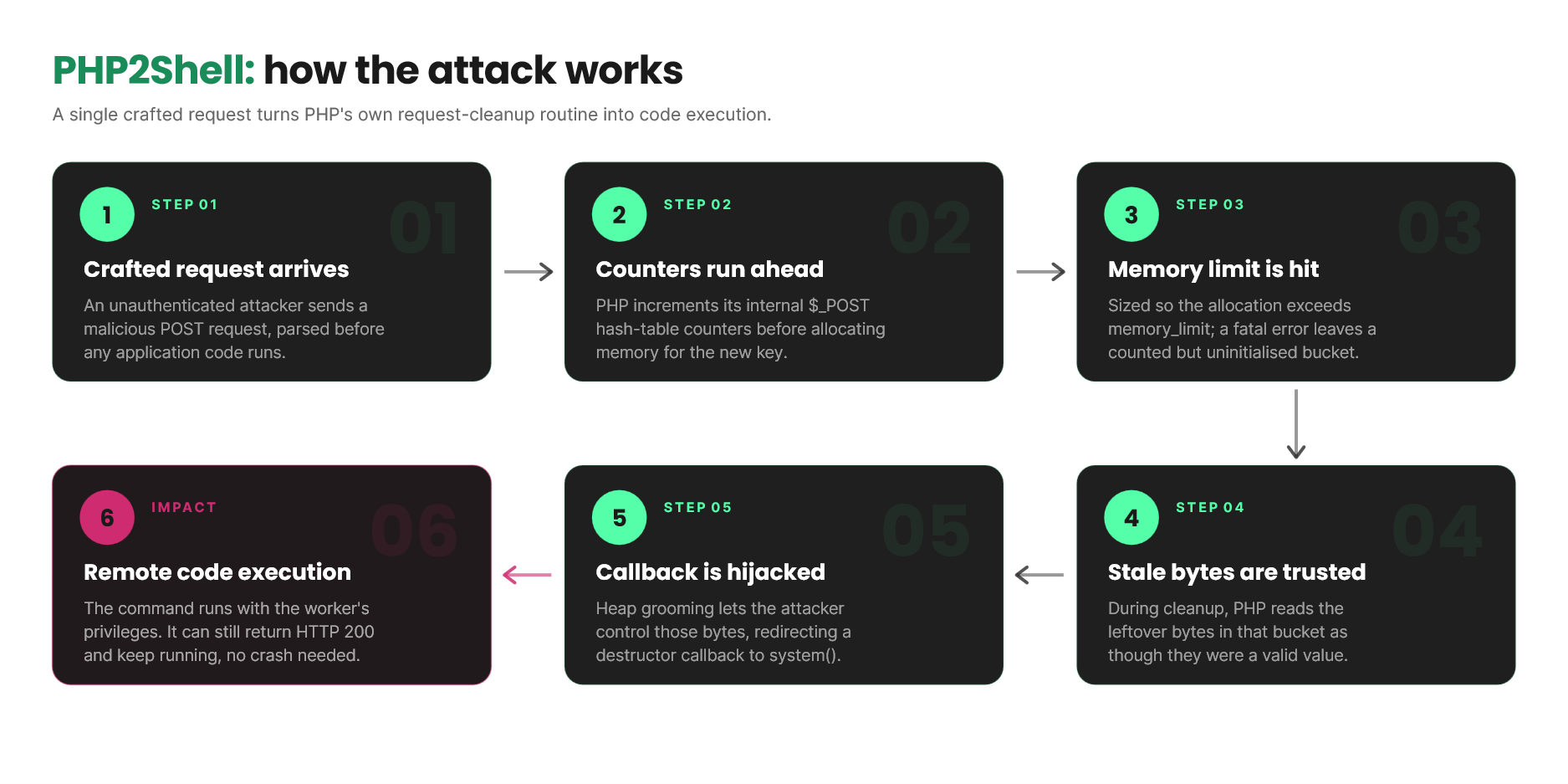
Both vulnerabilities share a common underlying pattern: a fatal error, typically caused by memory exhaustion, interrupts PHP partway through an internal operation, and PHP later treats the incomplete or stale state as though it were valid.
CVE-2026-109618
can be triggered while PHP is processing submitted form data, before application code runs. In one demonstrated exploit path, PHP increments the counters for the internal hash table behind the $_POST array before successfully allocating memory for a new key. An attacker can construct a request that causes this allocation to exceed memory_limit, leaving a counted but uninitialised bucket. During request cleanup, PHP can interpret leftover bytes in that bucket as a valid value. By carefully grooming heap memory, an attacker can control those bytes and ultimately redirect a destructor callback to the C system() function with a command of their choosing.
CVE-2026-109619
involves stale state surviving across requests. A PHP worker handles multiple requests during its lifetime, and a fatal error can cause request-owned memory to be freed without clearing worker-wide pointers that reference it. A subsequent request handled by the same worker can then follow the stale pointer into reclaimed memory. Confirmed exploitation paths include fatal-error backtraces in PHP 8.5 and upload processing involving session upload-progress functionality, which is enabled by default and operates before the application needs to call session_start(). A separate OPcache type-confusion variant can also corrupt shared PHP state and lead to code execution.
To make the demonstrated RCE exploit reliable, an attacker must also overcome address-space layout randomisation (ASLR). Memory disclosure can substantially reduce this obstacle by leaking process memory through a URL-encoded PHPSESSID response cookie, potentially exposing pointers that remain valid within the targeted worker. Crucially, successful exploitation does not necessarily crash the worker: Datadog Security Labs demonstrated a refined exploit that returned HTTP 200 while the same Apache worker continued running after executing the attacker's command. A successful HTTP response is therefore no assurance that the request was harmless.
A successful HTTP response is no assurance that the request was harmless.
Recommendations
Patch to a fixed release immediately
The first fixed versions are 8.2.35, 8.3.36, 8.4.27 and 8.5.12. PHP has also published source backports for 7.4, 8.0 and 8.1 despite those branches being outside normal support; organisations using older branches should apply an appropriate vendor-provided package where available or migrate to a supported branch.
Inventory every PHP runtime, not just the obvious ones
Include container images and applications that bundle their own PHP interpreter. Rebuild and redeploy affected images, then restart or replace workers to ensure none remains on vulnerable code. Verify the version used by the web-serving runtime rather than relying solely on the CLI installation, which may use a different PHP version or configuration.
If you cannot patch immediately, restrict access to internet-facing applications and use controls at a reverse proxy, WAF or other boundary to block malicious requests before they reach PHP's vulnerable parser
These controls should be treated strictly as temporary mitigations rather than substitutes for patching.
Apply the interim php.ini mitigations as an additional layer, not a cure
For CVE-2026-109618, set memory_limit=-1 at administrator level and combine this with frontend request-size and container memory limits. For CVE-2026-109619, set session.upload_progress.enabled=0 and, on PHP 8.5, fatal_error_backtraces=0, then restart affected workers. These measures reduce exposure but do not fully address the underlying vulnerabilities.
Hunt for exploitation across multiple layers
Correlate unusual multipart or form submissions with memory-exhaustion errors during request initialisation, unusually large or malformed PHPSESSID response cookies that may indicate memory disclosure, and unexpected shell or command processes spawned by PHP or web-server workers. Pay particular attention to unusual use of session upload-progress functionality and repeated requests designed to trigger memory limits. No single indicator is conclusive, and successful exploitation does not necessarily crash the affected worker or return an HTTP error.
Detection opportunity
Hunt: suspicious child processes from PHP
Detects suspicious applications being run from PHP-related processes.
let PHPParents = dynamic([
    "php.exe", "php-cgi.exe", "php-fpm.exe",
    "httpd.exe", "apache.exe", "apache2.exe",
    "php", "php-cgi", "php-fpm", "httpd", "apache2"
]);
let SuspiciousChildren = dynamic([
    "cmd.exe", "powershell.exe", "pwsh.exe",
    "bash", "sh", "dash", "zsh",
    "curl", "curl.exe", "wget", "wget.exe",
    "python", "python3", "python.exe",
    "perl", "perl.exe", "nc", "ncat",
    "certutil.exe"
]);
DeviceProcessEvents
| where InitiatingProcessFileName in~ (PHPParents)
| where FileName in~ (SuspiciousChildren)
| project Timestamp, DeviceName,
    InitiatingProcessFileName,
    InitiatingProcessCommandLine,
    FileName, ProcessCommandLine,
    AccountName, FolderPath
| order by Timestamp descTeams vishing and phishing
| Message-based phishing | Voice phishing |
|---|---|
| External chats deliver malicious links, file-sharing lures or QR codes. | Attackers impersonate IT support and persuade employees to grant remote access. |
Microsoft Teams is abused for two related forms of social engineering. In message-based phishing, attackers use Teams chats to deliver lures such as malicious links, file-sharing lures or QR codes designed to redirect users towards fraudulent or credential-harvesting content. In voice phishing, or vishing, attackers go a step further and get the target onto a call, often posing as internal IT or helpdesk personnel to persuade them to grant remote access to their machine. Teams-based vishing has increasingly been adopted by financially motivated threat actors and has been associated with ransomware operations. Both techniques exploit the same underlying weakness: the trust an organisation places in its own collaboration platform. Where PHP2Shell attacks the software, Teams phishing and vishing attack the user.
The reported increase
The growth through 2026 is visible across multiple vendors’ telemetry, on both the voice and the message side. Microsoft reported that weekly malicious Teams call attempts had increased by roughly 80% since the beginning of 2026 and reached nearly ten times the mid-2025 baseline by late June. On the message side, Microsoft reported that Teams-based phishing detections increased 19% from March to April, remained broadly flat in May, and rose a further 10% in June. Sophos, which tracks the technique through its Managed Detection and Response cases, recorded a sharp rise in Teams vishing from January 2026, with further jumps in March and May. It assesses that while improved detection may explain part of the increase, the trend more strongly suggests growing adoption of the technique as an initial-access vector.
The technique is not new. Microsoft first publicly documented IT-themed Teams vishing in mid-2024, and similar activity has since been associated with ransomware operations including BlackBasta and 3AM. However, observed campaigns have become increasingly sophisticated. Zscaler ThreatLabz tracked a cluster of related attacks from January 2026 in which the tooling evolved over time, with more recent activity becoming increasingly selective and focused on corporate environments. A particularly clear example is the campaign Sophos tracks as STAC4749, which targeted dozens of North American organisations between February and June 2026, with approximately 94% of observed cases affecting organisations in Canada and the US. At least three compromises culminated in Chaos ransomware deployment, including one in which the attackers progressed from initial access to ransomware deployment in less than 17 hours.
Message-based phishing on Teams
The chat channel is a delivery vector, not just a means of establishing voice contact. Because Microsoft Teams supports communication with external users, attackers can contact employees directly from outside the organisation and deliver phishing lures through Teams chats. Microsoft has introduced specific protections against spam, phishing and impersonation from external contacts, while Microsoft Defender for Office 365 can provide time-of-click protection against malicious URLs in Teams.
Microsoft documented the financially motivated actor Storm-0324 using this approach as far back as July 2023, distributing phishing lures through Teams chats as part of its malware-delivery activity. Storm-0324 acts as a distributor that hands compromised access to other threat actors, with Microsoft reporting that these hand-offs frequently lead to ransomware deployment. More recent defensive changes also reflect the growing diversity of Teams-based phishing. QR codes embedded in messages can direct victims towards phishing or fraudulent content while concealing the destination behind an image. In October 2026, Microsoft Teams introduced protection that obscures QR-code images from external senders by default and requires users to explicitly reveal them before scanning. Message-based phishing should therefore be treated as a distinct Teams attack vector alongside the voice-based social-engineering activity described below.
Teams vishing attack sequence
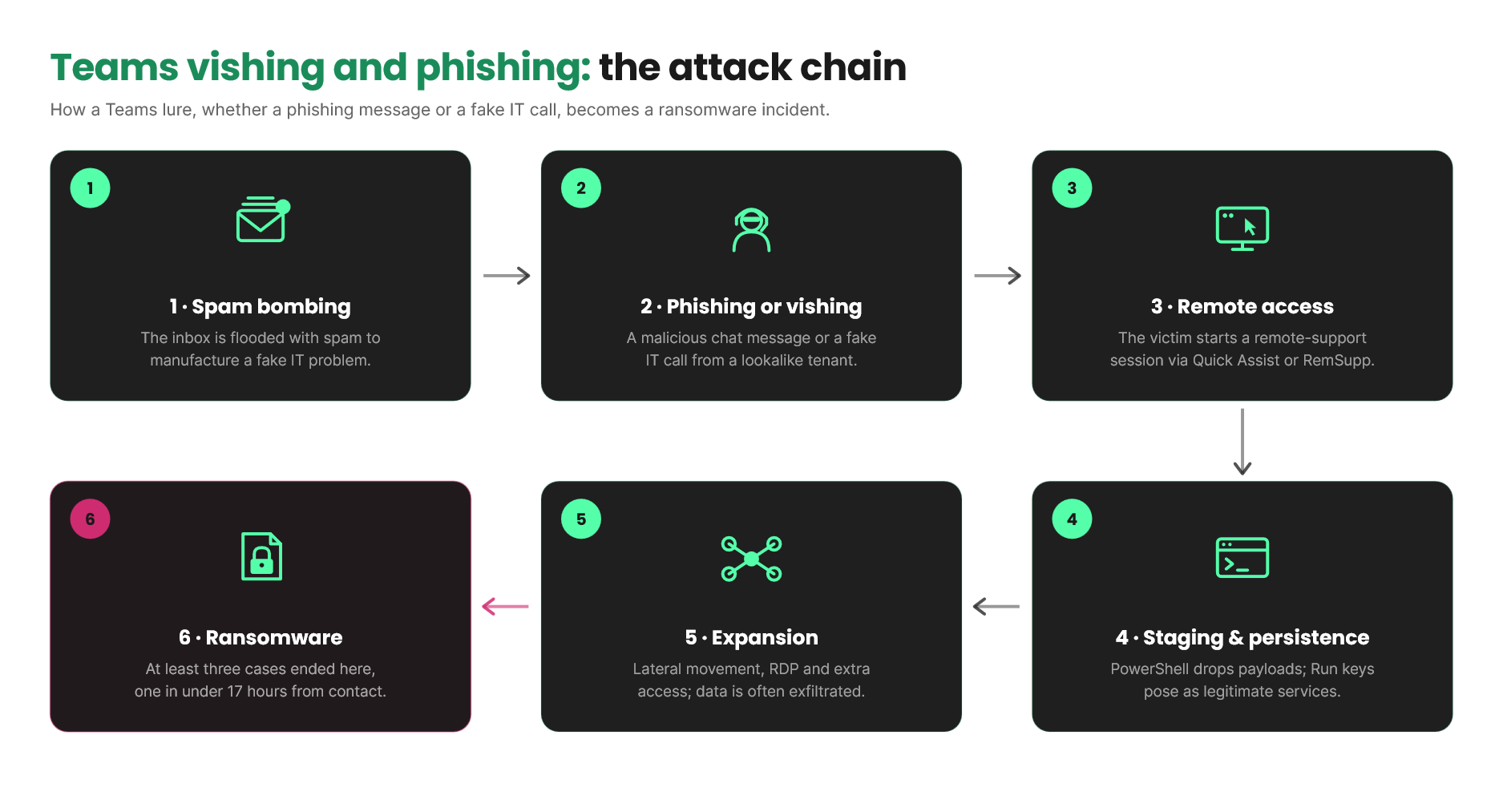
The attack chain observed across multiple campaigns relies primarily on social engineering rather than exploitation of a software vulnerability:
Spam bombing to manufacture a pretext
The attack often begins with a high volume of spam being sent to the target's inbox, creating an apparent technical problem that gives the attacker's subsequent offer of IT assistance greater credibility.
Impersonation over Teams
The attacker contacts the victim through a Teams chat or call, posing as IT or helpdesk personnel offering assistance. In the STAC4749 campaign, operators registered IT-themed domains under the .top TLD, including supportsoft[.]top and info-secure[.]top, and paired them with plausible employee usernames. Calls ranged from around 90 seconds to more than 20 minutes, although most lasted approximately two to two-and-a-half minutes.
Remote access
The caller persuades the employee to establish a remote-support session. STAC4749 initially favoured Microsoft Quick Assist, using RemSupp when Quick Assist was blocked or unavailable. From April, operators increasingly favoured RemSupp, which Sophos assesses was likely because it was less commonly included in application blocklists.
Staging and persistence
Once remote access is established, the attacker can execute commands and deploy additional tooling. In STAC4749 incidents, operators used PowerShell to retrieve malicious payloads from attacker-controlled infrastructure, typically staging them in user-writable directories such as AppData\Roaming. The campaign also established persistence through registry Run keys masquerading as legitimate components, including Realtek audio services.
Expansion and impact
From the initial foothold, operators may establish additional remote-access channels and move laterally through the environment. STAC4749 included attempts to enable RDP and, in several incidents that subsequently led to Chaos ransomware, deployed tools such as DWAgent and AnyDesk. At least one incident also showed evidence consistent with likely data exfiltration. With Sophos documenting one STAC4749 intrusion progressing from initial access to ransomware deployment in less than 17 hours, a successful Teams-vishing event should be treated as an active security incident rather than a routine helpdesk issue.
Recommendations
Because these techniques target people and trusted tools rather than a patchable flaw, defence requires a combination of configuration, monitoring and training. Several of the controls below blunt both the message-based phishing route and the voice-based vishing route at once.
Lock down external Teams communication
Restrict or disable external Microsoft Teams chat and calls where the business does not require them, and allow-list only trusted partner domains where appropriate. Separately review external file-sharing policies in SharePoint and OneDrive. This reduces exposure to two delivery channels at once: the voice calls used in vishing and the malicious messages, links and file-sharing lures used in Teams phishing. Microsoft recommends limiting domains for external Teams access as part of reducing the platform's attack surface.
Filter malicious links and files inside Teams
Ensure Microsoft Defender for Office 365 protections are appropriately configured for Teams. Safe Links provides protection for URLs shared through Teams, including time-of-click checking, while Safe Attachments for SharePoint, OneDrive and Teams provides an additional layer of protection by analysing files and restricting access to those identified as malicious. Review external sharing policies in SharePoint and OneDrive, and treat QR codes, or quishing, as a live phishing lure. Teams began obscuring QR codes from external senders by default in October 2026, but users should still verify the sender before revealing or scanning them.
Control remote-support tools
Enforce application-control policies to restrict unauthorised use of Quick Assist, RemSupp, AnyDesk, DWAgent and similar RMM utilities. Attackers may switch to less commonly blocked tools when preferred options are unavailable, so approved-software policies and blocklists should be regularly reviewed and updated. In STAC4749, operators increasingly favoured RemSupp after initially using Quick Assist, which Sophos assesses was likely because it was less commonly included in application blocklists.
Train staff on the specific scenarios
Users should be taught to treat two kinds of unexpected contact with caution: an IT or helpdesk approach requesting remote access, particularly when it follows an unexplained flood of spam, and an unexpected message carrying a link, file-sharing notification or QR code, especially from outside the organisation. In both cases, employees should have a clear, rehearsed method for independently verifying the contact through a known internal channel before granting remote access, clicking links or running unfamiliar tools.
Monitor for the behavioural chain
Investigate suspicious external Teams calls and chats, particularly unexpected messages containing URLs, QR codes or file-sharing links. Alongside these, alert on abnormal PowerShell execution, unauthorised remote-access or tunnelling tools, and suspicious registry Run keys or Startup-folder entries. EDR and identity telemetry that correlates these behaviours can provide visibility into attacker activity before persistent access is established. The latter behaviours are consistent with the post-compromise activity observed by Sophos in STAC4749.
Audit persistence locations routinely
Regularly review registry Run keys, Startup-folder entries and other common persistence locations for suspicious entries masquerading as legitimate services or applications. This can help uncover established footholds and reduce the risk of persistence surviving remediation. STAC4749, for example, used registry-based persistence while masquerading as legitimate components.
Bridewell CSIRT Detection Rules & Analytics
The following detection content was generated through our managed threat intelligence, threat hunting, and detection and response (MDR) services. The content automatically protects our customers from known and emerging threats.
| Detection Analytic Concept | Category |
|---|---|
MDE_Device_NetworkEvents_Suspected_DRPK_Campaign_Staging_PHP2Shell_IOC | Command and Control |
MDE_DeviceFileEvents_PHP2Shell_Generic_UnexpectedPHPProcessFileCreation | Persistence, Defence Evasion |
MDE_DeviceEvents_PHP2Shell_Generic_BaselinePHPExecutionAnomalies | Execution |
MDE_CommonSecurityLog_PHP2ShellUSerAgent | Initial Access |

BCON Collective
Cyber Threat Intelligence Team